Seedly CRM Vs HubSpot in 2026
Skip the bill.
I got fed up renting my agency on GoHighLevel, researched every serious alternative including HubSpot, and built my own instead. Here is the honest comparison, including where HubSpot wins.


Which one fits your work?
Pick Seedly CRM if you want the source code, control of your hosting, and room to shape the CRM around your agency.
Pick HubSpot if you need a managed suite with deep reporting, a large integration ecosystem, and vendor support.
Seedly CRM
$1,599one timeHubSpot
$800/mo, on ProPlus $3,000 to onboard. And it climbs as you grow.
THE HONEST VERSION
I have not run my agency on HubSpot. So here is the honest version.
That is the whole point of this page, so I will be straight with you up front: I never ran my business on HubSpot. What I did do, after I got fed up renting my agency on top of GoHighLevel, was sit down and seriously evaluate every alternative I could switch to. HubSpot was the first name on the list.
Here is what I found. HubSpot is genuinely excellent software, and it is also built for a different buyer than most agencies and small operators. The marketing automation you actually want, the workflows, does not show up until Marketing Hub Professional, which is $800 a month billed annually plus a one-time $3,000 onboarding fee before you send a single email. The price for contacts climbs on its own as your lists grow; crossing a tier upgrades you automatically, and there is no mid-term downgrade.
Every option I looked at had the same root problem GoHighLevel did. You are renting. So I stopped shopping for a landlord and built the thing I wanted to own instead. That is Seedly, and this is the honest comparison between the two.
At a glance.
| Capability | Seedly CRM | HubSpot |
|---|---|---|
| Price model | $1,599 once | $800/mo + $3,000 onboarding (Marketing Hub Pro) |
| Seats and users | Unlimited, no per-seat feesOur advantage | Per seat; +$45/mo per extra Core seat on Pro |
| Per-contact pricing | None, your list size is your businessOur advantage | Climbs as marketing contacts grow, auto-upgrades you |
| You own the source code | Yes, the full codebaseOur advantage | No, you rent access |
| Own the source / control your infra | Yes, source you own, on infrastructure you controlOur advantage | No, HubSpot cloud only |
| White-label client sub-accounts | Unlimited, no per-account feeOur advantage | No native equivalent; Business Units (now Brands) is an Enterprise add-on |
| Where your client data lives | On servers you controlOur advantage | On HubSpot's servers |
| Workflow automation | 80 nodes, 76 triggers, included | Deep, but gated to Professional and up |
| Onboarding fee | None, you deploy it yourself | $3,000 one-time on Professional |
| Integrations / ecosystem | Build any integration on code you own | 2,000+ marketplace integrationsTheir advantage |
| Managed hosting | You host it (or Convex Cloud) | Fully managed, zero opsTheir advantage |
| Support and training | Docs, a community, and you own the code | Support, onboarding, HubSpot AcademyTheir advantage |
Price model
- Seedly CRM
- $1,599 once
- HubSpot
- $800/mo + $3,000 onboarding (Marketing Hub Pro)
Seats and users
- Seedly CRM
- Unlimited, no per-seat feesOur advantage
- HubSpot
- Per seat; +$45/mo per extra Core seat on Pro
Per-contact pricing
- Seedly CRM
- None, your list size is your businessOur advantage
- HubSpot
- Climbs as marketing contacts grow, auto-upgrades you
You own the source code
- Seedly CRM
- Yes, the full codebaseOur advantage
- HubSpot
- No, you rent access
Own the source / control your infra
- Seedly CRM
- Yes, source you own, on infrastructure you controlOur advantage
- HubSpot
- No, HubSpot cloud only
White-label client sub-accounts
- Seedly CRM
- Unlimited, no per-account feeOur advantage
- HubSpot
- No native equivalent; Business Units (now Brands) is an Enterprise add-on
Where your client data lives
- Seedly CRM
- On servers you controlOur advantage
- HubSpot
- On HubSpot's servers
Workflow automation
- Seedly CRM
- 80 nodes, 76 triggers, included
- HubSpot
- Deep, but gated to Professional and up
Onboarding fee
- Seedly CRM
- None, you deploy it yourself
- HubSpot
- $3,000 one-time on Professional
Integrations / ecosystem
- Seedly CRM
- Build any integration on code you own
- HubSpot
- 2,000+ marketplace integrationsTheir advantage
Managed hosting
- Seedly CRM
- You host it (or Convex Cloud)
- HubSpot
- Fully managed, zero opsTheir advantage
Support and training
- Seedly CRM
- Docs, a community, and you own the code
- HubSpot
- Support, onboarding, HubSpot AcademyTheir advantage
HubSpot pricing reflects Marketing Hub Professional at $800/mo billed annually ($9,600/yr) plus a one-time $3,000 onboarding fee, the tier where HubSpot's visual workflow automation begins. It includes 3 seats and 2,000 marketing contacts, and both seats and contacts cost more as you grow. HubSpot's Free and Starter ($7/seat/mo) tiers exist but include only basic form follow-up automation, not the visual workflows, so this compares like for like. Pricing per hubspot.com, verify the current numbers before relying on them. Checked against hubspot.com on 2026-11-02.
Sources checked: HubSpot Marketing Hub pricing, HubSpot Sales Hub pricing.
THE REAL THING
See the software.
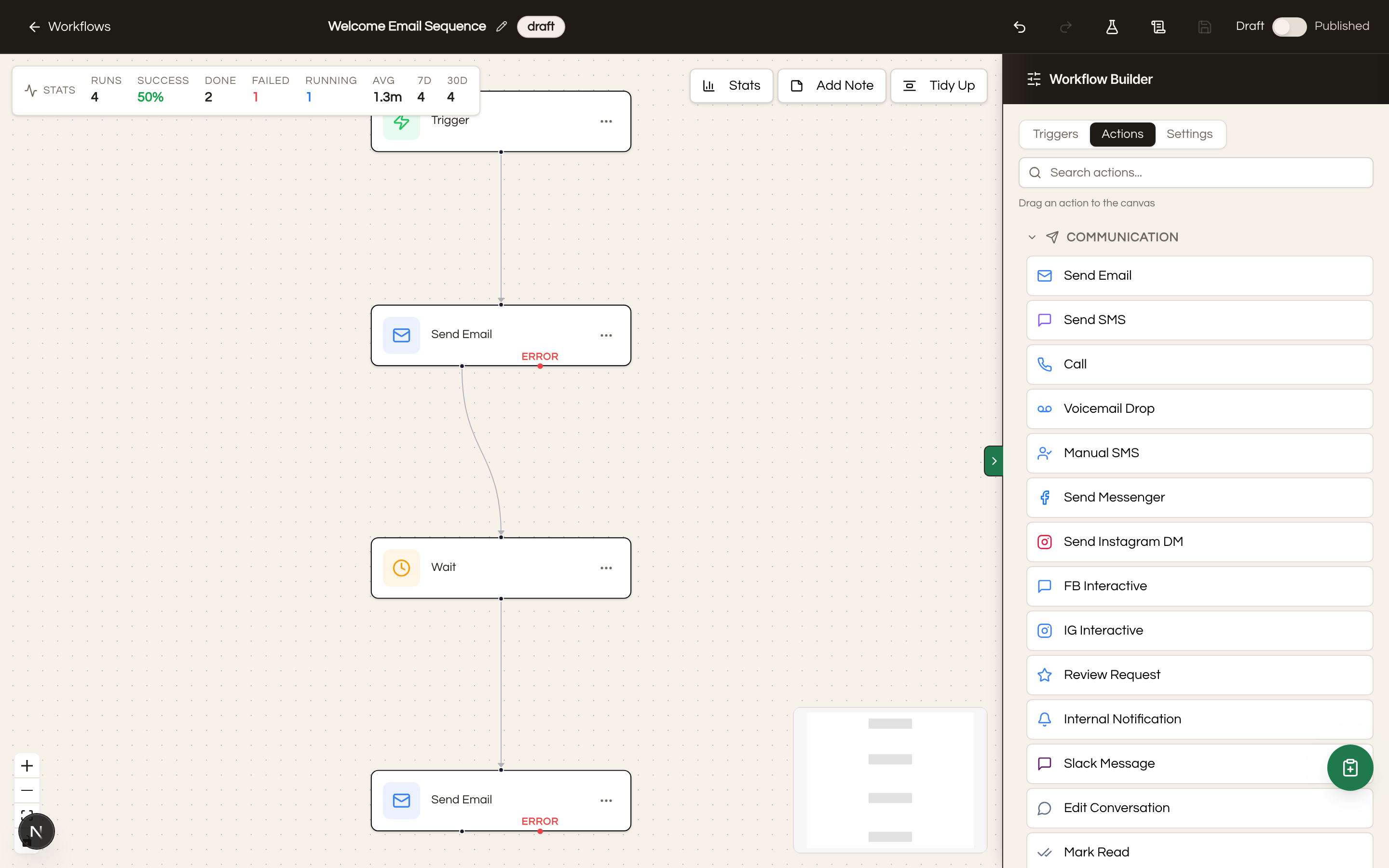
One is a purchase. The other is $9,600 a year before you add a seat.
To get the marketing automation most agencies actually want from HubSpot, you are on Marketing Hub Professional. That is $800 a month billed annually, $9,600 a year, plus a one-time $3,000 onboarding fee before you send your first email. Add seats at $45 a month each, and watch the bill climb on its own as your contact list grows.
Seedly is $1,599 one time. You cover your own hosting after that, which for most people runs somewhere between $25 and $200 a month depending on how hard you push it. You are usually ahead of HubSpot inside the first few months, and the gap only widens, because their number resets every January and yours does not.
And the HubSpot figure is the floor, not the ceiling. The contact escalator means the more you succeed, the more you pay, automatically and without asking. Owning the software means your success stays yours to keep.
What ownership changes.

You own the code, not a login
With Seedly the actual software is yours. Change anything, add anything, integrate with anything. No marketplace to wait on, no API limits to bump into, no permission to ask for. If you can describe it, you (or Claude Code) can build it on top of a foundation that already runs.

No more surprise updates, no more surprise bills
On a managed platform, changes ship on the vendor's schedule and the price moves on the vendor's terms. With Seedly you pull updates when you want them and merge in only the pieces you actually want. Nothing gets forced onto your build the night before a client launch, and no tier you crossed quietly bumps your invoice.

White-label without the tier tax
Run unlimited client sub-accounts, each one branded as its own product, with no per-account fee. HubSpot has no native equivalent; the closest option, Business Units (now called Brands), is a Marketing Enterprise add-on that still shares one underlying database. On Seedly, white-label is just how it works, because you own the whole thing.

Your client data lives on your servers
Not on a vendor's. If Seedly disappeared tomorrow, your CRM keeps running and your clients never notice. That is the difference between owning an asset and renting access to one.
What you are actually buying.
With HubSpot you are buying access, billed per seat and per contact, for as long as you stay. It is a polished, powerful platform, but the day you stop paying, the access ends and your data export is all you walk away with.
With Seedly you are buying the actual software. The files sit on your machine. You could never speak to me again and your business keeps running exactly as it did. That is the whole difference, and it is the reason I built this instead of signing another annual contract.
Coming from HubSpot? Your data comes with you.
HubSpot lets you export your contacts, companies, and deals to CSV, and that is the part you actually need. Bring them into Seedly and run both side by side while you rebuild, so nothing goes dark for a client mid-move.
Workflows get rebuilt on Seedly's canvas rather than imported one to one. Most people treat that as the point, not the chore, because it is the moment you finally delete the automations you were paying for and never used. Sprout, the setup guide built into the product, walks you through deploying it in plain English, or you point Claude Code at the repo and it sets everything up for you.
When HubSpot is the right call (and I mean it).
HubSpot is a genuinely great platform, and for the right company it is the obvious choice. If you are a funded team that wants one managed system for marketing, sales, and service, with deep reporting, two thousand-plus integrations, AI features, and a support line and an Academy to lean on, HubSpot earns its price. You are not the person I built Seedly for, and that is completely fine.
Seedly is for the operator who does not want to rent, who would rather own the software their business runs on and not watch the bill climb every time they grow. If a fully managed enterprise platform is what you need, HubSpot will serve you well, and I would rather tell you that than talk you out of the right tool.
BEFORE YOU DECIDE
Questions about Seedly CRM and HubSpot.