
Loading article…
Economics
I stopped renting my CRM and started hosting my own. Here's what it actually costs, what broke, and whether I'd do it again.
Andrew Lee Jenkins · 2026-04-28 · 6 min read · Updated 2026-09-25
Loading article…
KEEP READING

Economics · 7 min read
Read article

Ownership · 6 min read
Read article


Economics · 10 min read
Read articleThis is a self-hosted CRM vs. SaaS comparison with real numbers from someone who made the switch. If you're researching self-hosted CRM software, these are the actual costs, tradeoffs, and hosting details from running a self-hosted CRM for my own agency.
I was paying $497/month for my CRM, plus $299/month for a marketer's toolkit add-on and $100/month for premium workflow actions to make it work the way I needed. That's $10,752/year before a single one of those prices moved.
Then my platform pushed an update that quietly broke a flow I'd spent weeks tuning for clients. Monday morning came and dozens of forms were messed up and I was the one explaining it to someone who didn't care whose fault it was.
That was the moment I stopped pretending the platform was mine. I was renting a business on top of someone else's roadmap, and every month I paid for the privilege of hoping they wouldn't change something I depended on.
The math stopped working in my head. I kept thinking about how many hours I'd lost reverse-engineering their updates instead of building anything for myself or my clients.
So I started self-hosting my CRM.
Let me be clear about what this is and isn't.
Self-hosting your CRM means you own the source code and deploy it on infrastructure you control. The backend runs on Convex Cloud by default, so the database, backups, and scaling are managed for you and the day-to-day stays light. What you actually own is the code and the decision of when to update. No vendor is going to push a change to your build at 2 AM, and if something needs fixing, you fix it instead of filing a ticket and hoping.
This is NOT a product for someone that's not ready to take on that responsibility. There's a big gap between being frustrated with a software and taking ownership of managing and self-hosting. If you're not there yet, there's definitely value in not switching.
I want to be upfront about that because I'm tired of vendors pretending there are no tradeoffs.
Explore Seedly's codebases and read the setup guides before choosing your software.
Explore the codebasesThrough the entire development and self-testing process, I have not gone above the free tier for hosting. Here's how costs scale based on actual usage.
Solo operator or small team (1-5 users, light use)
Growing agency (10-20 users, moderate use)
Busy agency (20+ users, heavy daily use)
Compare that to what I was actually paying on SaaS before this - $497/month for the plan, $299/month for a marketer's toolkit add-on to make it behave, and $100/month for premium workflow actions. $896/month, every month, and seats had nothing to do with it. The same workload self-hosted costs maybe $50-100/month in infrastructure. I mapped out the full 5-year comparison in What Your CRM Actually Costs Over 5 Years.
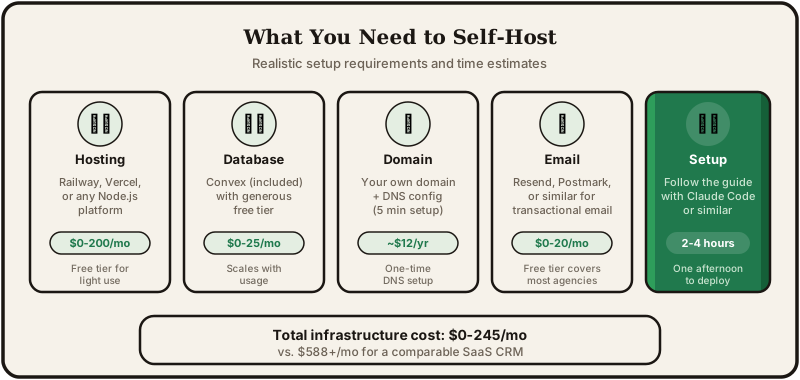
Keep in mind this IS some assembly required. You will have to self-host this and you will want to at least be somewhat comfortable with using Claude Code or another coding tool.
Here's the realistic setup list.
The setup isn't a weekend project like some vendors claim, but it's not a month-long ordeal either. With the documentation included, most technically comfortable people can get a working deployment in an afternoon.
I'd be lying if I said nothing went wrong. Here's what actually happened.
OAuth configuration was the biggest pain point. Connecting Google, Microsoft, and other providers requires creating developer apps and managing credentials. It's not hard, just tedious and poorly documented by the providers themselves.
Email deliverability takes some initial configuration. You need to set up SPF, DKIM, and domain verification. Skip this and your emails land in spam.
The first deployment took longer than expected because I was learning the hosting platform's quirks at the same time. The second deployment (when I set up my personal agency instance) took about 90 minutes.
None of these were problems with the CRM itself. They were infrastructure configuration tasks that you do once and never touch again.
Automatic updates.
On a SaaS platform, features appear without you doing anything. That sounds great until you remember that broken features also appear without you doing anything. And the features they add aren't always the ones you wanted (I really wish they would focus on CRM functionality instead of trying to remake Zoom and Lovable).
With self-hosting, YOU decide when to update. You review the changes, test on a staging environment if you want, and deploy when you're ready. No surprises.
I consider this a feature, not a loss. But if you want zero maintenance and don't mind the tradeoff of zero control, SaaS is the right choice for you. If you're on the fence, I explain why forking beats building from scratch.
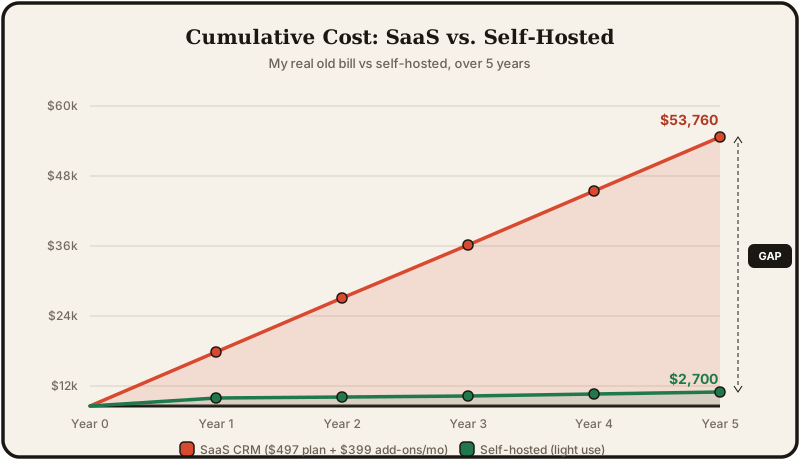
| SaaS (my real old bill) | Self-hosted | |
|---|---|---|
| Year 1 | $10,752 (plan + add-ons) | $1,599-3,100 (code + hosting + setup) |
| Year 2 | $10,752 | $300-1,200 (hosting only) |
| Year 3 | $10,752 | $300-1,200 |
| Year 4 | $10,752 | $300-1,200 |
| Year 5 | $10,752 | $300-1,200 |
| 5-year total | $53,760 | $2,800-7,900 |
And the SaaS number assumes no price increases and no new add-ons creeping in. In reality, it drifts higher.
There's no shame in paying for convenience. The question is whether you're paying for convenience or paying because you don't realize there's another option.
You will retain ownership of the full codebase and will save yourself your share of the 1,200+ hours and $2,000+ in AI tokens I spent building all four Seedly products.
May you be able to use this as a springboard to build something that gives you complete control. Or rip everything apart and resell it for profit. I don't really care as long as it helps you move forward.
One payment. Full source code. Unlimited seats. Yours forever.
If you also want to resell your CRM to clients, read The White-Label CRM Playbook. And if your CRM data has been accumulating unchecked, start with the Saturday data audit before you migrate anything.
Cut the strings.